How high must a pool fence be in NSW? What the council page says
The Swimming Pools Act sets the duty. Section 7 says the owner must ensure the pool is at all times surrounded by a child-resistant barrier that separates it from any residential building on the premises and is designed, constructed, installed and maintained in accordance with the standards the regulations prescribe (the Act, in a version amended to 2008). The heights below come from the Wagga council page, which says the barrier is at least 1.2 m high around the perimeter, and 1.8 m where a boundary fence forms part of the barrier, measured from inside the pool enclosure.
Those are the figures on the Wagga council page, which works to the edition the council pages cite, AS 1926.1-2012. A 2024 edition has been published, and no NSW page we found says which edition a certifier applies to a new fence today. Ask the council or your certifier which edition and which dimensions apply to your pool and fence before you buy or build.
| Item | What the Wagga council page says |
|---|---|
| Perimeter barrier | At least 1.2 m high around the perimeter |
| Boundary fence in the barrier | 1.8 m, measured from inside the pool enclosure |
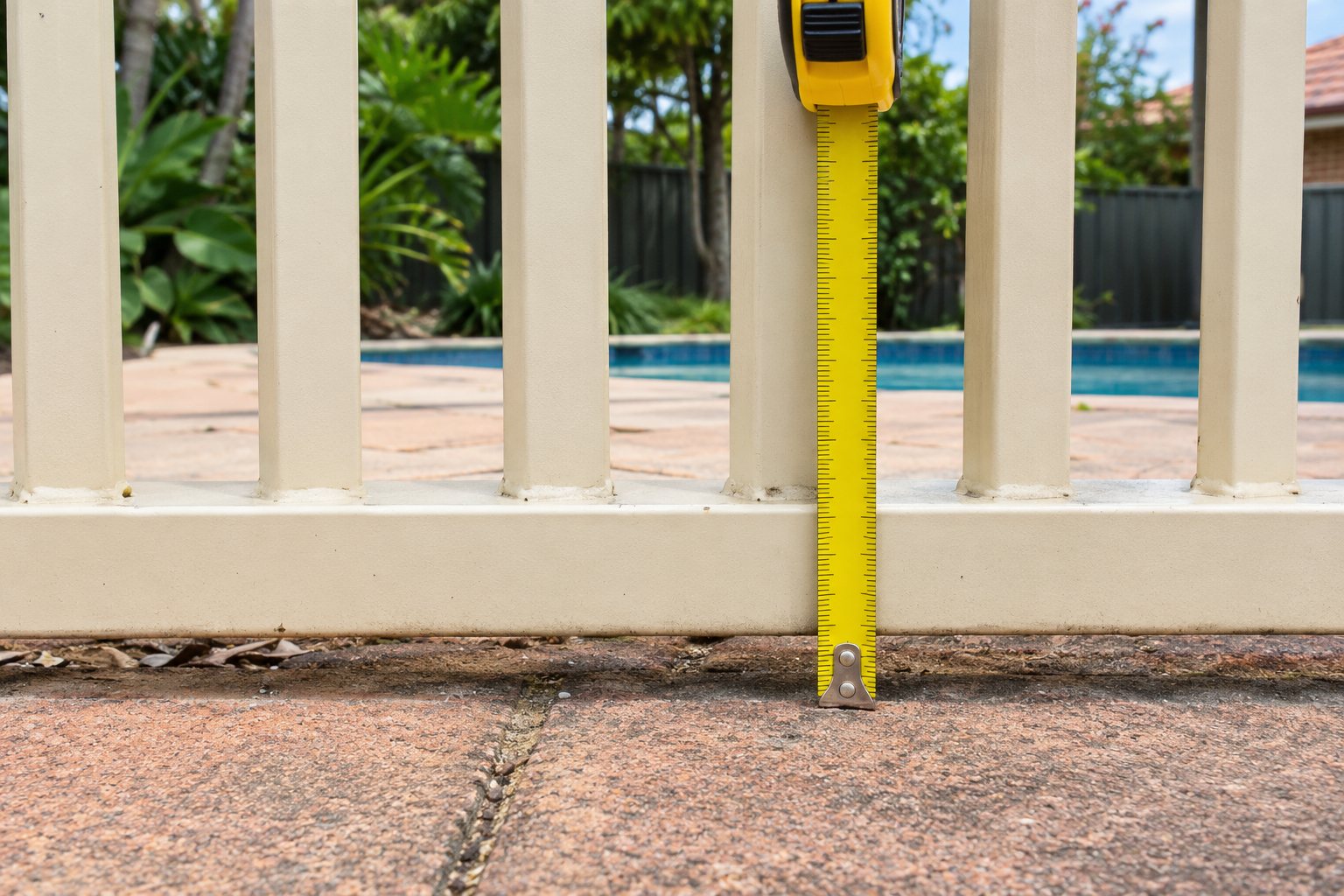
| Gap under the barrier | No more than 100 mm between the bottom of the fence and finished ground level |
| Gaps between components | No more than 100 mm |
| Horizontal components | At least 900 mm apart |
| Non-climbable zone | Extends 300 mm into the pool area and 900 mm outside it |
| Mesh or perforated barrier | 1.2 m, with holes no larger than 13 mm |
| Gates | Open outwards, and are fully self-closing and self-latching |
| Pool doors | Self-close and self-latch. The page also sets a minimum latch height for doors, which this site does not repeat because sources differ on latch heights |
| Pool windows | Lock, or have a screen, limiting the opening to 10 cm |
| Warning sign | Able to be read easily from 3 m |
The table lists what a council page says. It is not a statement of the law and it is not a design guide. The non-climbable zone page covers objects, walls and privacy screens near the fence, and the boundary fence page covers shared fences.
Gates, latches and an older barrier book
The council page says a gate opens outwards and is fully self-closing and self-latching, and that a gate which does not latch must be fastened closed until it is fixed. The council's Swimming Pool Safety Policy POL 049 says gates must be kept closed at all times. Because sources differ on latch heights, this site gives no latch figure. Read the council page and ask your certifier about your latch. A gate that has stopped latching is a repair job, and the pool fence repairs page covers it.
One neutral line from an older source. A 2013 barrier book prepared for NSW councils says gates within a boundary fence and double gates are not acceptable, and recommends a gate width of no more than 1 metre. It cites the 2012 edition and is older than the 2024 edition, so treat it as background and ask the council.
Which AS 1926.1 edition applies? No NSW page says
Three editions are in play: 2007 and 2012, named in council and NSW pages, and a second edition published in 2024. The table shows what each source says and when.
| Source | What it says | Date |
|---|---|---|
| Wagga council legislation page | Ties the 1986, 2007 and 2012 editions to pool build dates, in wording where the date ranges leave gaps | No date shown |
| Wagga council pool fencing page | Says the fence is built, installed and maintained to AS1926.1-2012, and that older pools may follow older versions | No date shown |
| NSW owner obligations page | Barriers modified during renovations must meet AS1926.1-2012, and previous exemptions end | Updated 16 March 2026 |
| Another NSW council's inspection program | Cites AS1926.1 (2012) | Approved June 2026 |
| Preview page of AS 1926.1:2024 | Second edition, and its preface says it is to supersede AS 1926.1:2012 | Published 23 August 2024 |
| Royal Life Saving Australia | The new standard introduces new definitions, revised non-climbable zone requirements, improved gate latch and hinge security and guidelines for combined structures. It does not say when the standard becomes mandatory | 3 September 2024 |
| HIA | Says the 2024 edition is referenced in NCC 2025, currently applies in Victoria and will not be enforced elsewhere until those states adopt NCC 2025 | Not dated in our notes |
| NSW Government release | NSW will adopt NCC 2025 on 1 May 2027. The release does not mention pools | 25 March 2026 |
| NCC 2022, NSW H7 page | Cites no edition of AS 1926.1, and says the Swimming Pools Act and Regulation prevail in any inconsistency | Not dated in our notes |
Read across, the table says this. The 2024 edition exists. NSW pages through June 2026 cite the 2012 edition. HIA says the 2024 edition will not be enforced outside Victoria until states adopt NCC 2025, and NSW says it will adopt NCC 2025 on 1 May 2027. No page we found says which edition a NSW certifier applies to a new or replaced fence today. We do not say the 2024 edition is, or is not, in force in NSW. Ask the council or your certifier. Sources for the table are linked in HIA's pool barriers article, the preview page, the Royal Life Saving Australia release, the NSW release and the NCC 2022 NSW page.
What does the 2024 edition change? It adds new glass test methods, revised non-climbable zone diagrams and changes to gate latches and hinges, according to the preview page and Royal Life Saving Australia. We give no clause detail, because the preview is partial.
Older pools are treated differently
The Swimming Pools Regulation 2018 (clause 30(2)) says that where a standard is amended or substituted, an existing barrier is treated as complying if it complied with the standard that applied to it at that time and still does. The NSW owner page says barriers modified during renovations must meet AS1926.1-2012 and previous exemptions end. The Wagga legislation page ties editions to build dates, and as the council page words it, the date ranges leave gaps. A pool built in a gap, or a fence you plan to alter, is a question for the council. The replacement and upgrades page looks at what changing a fence can trigger.
Who approves a barrier
POL 049 says each child-resistant barrier must be approved by the council's building surveyor or a private certifier. The council and registered private certifiers are the two kinds of inspector the pages name, and the steps are on the pool fence compliance page. For product pages, see glass pool fencing and aluminium pool fencing. Local notes for one suburb are on the Lake Albert page.
What a rules page cannot do
It cannot tell you what height or gap applies to your fence. It reports what the Wagga council page and other named sources say, and those sources cite an edition of the standard that a newer edition may supersede. It cannot say which edition your certifier will apply, how the council reads a gap in the build-date wording, or whether your fence would pass. The council decides, or the certifier does. Ask before you buy or build.
Check the current rules before you rely on this
This page describes the height, gap and gate figures on the Wagga council page and the evidence on which edition of AS 1926.1 applies in NSW. It describes the rules in general terms as they stood in November 2026. Standards, forms, thresholds and fines change.
The authoritative sources are Wagga Wagga City Council, pool fencing requirements, Wagga Wagga City Council, swimming pool legislation, NSW Government, owning a pool or spa: your obligations (updated 16 March 2026), Swimming Pools Regulation 2018 (NSW), version in force 30 June 2024, Standards Australia, AS 1926.1:2024 preview pages (partial, via ANSI webstore; flag: preview only, no clause detail) and Wagga Wagga City Council, Swimming Pool Safety Policy POL 049 (approved 17 October 2022). Where anything here differs from those sources, they are right and we are not.
We are not pool fencing contractors, certifiers, builders, regulators or lawyers. For what applies to your pool, ask Wagga Wagga City Council or your certifier which rules and which edition of the standard apply, ask the contractor which licence or registration they hold, and ask Building Commission NSW if you are unsure about licensing.
Accurate at the time of writing, November 2026. Always check the source before relying on it.